
Back to Basics Hoof Nutrition

I hope you find this blog post helpful! If you want a custom diet specific to your horse, click here.
P.S. We love AI, but this content is 100% human generated. 💕
Author: Dr Nerida McGilchrist | PhD Equine Nutritionist and Founder of My Happy Horse
Do a google or AI search about anything to do with hoof health and nutrition and you will be smacked in the face with a plethora of supplements and advice on how to fix your horse’s hooves!
Truth is, the basis for hoof health is just good, basic nutrition; making sure your horse’s gut is healthy and their diet balanced. A healthy gut and a balanced diet (and an excellent farrier or trimmer!) will give you healthy hooves in a vast majority of cases. There are of course situations where a more finessed approach is warranted. But these usually arise when foundational nutrition and/or management has gone awry.
The following article looks at the basics of hoof health nutrition… the things you can do in every day feeding to ensure your horse grows healthy hooves.
Healthy Gut, Healthy Hooves
As for most things equine health, hoof health is inextricably linked to gut health.
The good, fibre fermenting microbes in your horse’s hindgut are responsible for many things… including the production of the vitamin biotin. Biotin is crucial for strong hoof growth. And in healthy horses, that biotin is largely derived from the microbes in a healthy hindgut! Without a healthy hindgut, biotin production, and hoof health will faulter and the result will be weaker, slower growing hooves that are prone to issues.
Gut health though, plays an even more important role in hoof health, and that is, in maintaining proper immune function! Without proper immune function, hooves become prone conditions like thrush, abscesses and mud fever and you will find yourself forever battling these conditions externally.
Feeding the gut for hoof health
Feeding the gut for hoof health is the same as feeding the gut for health in general. There are 3 main principles to feeding for the kind of gut health that will give you the best possible hoof health and strong immune function.
Principle 1 – Lots of forage
Your horse’s good microbes will flourish when the hindgut is FULL of forage! As a general rule, for the best possible gut health, feed 2 to 3% of your horse’s bodyweight in forage per day. That’s 10 to 15 kg/day for an average 500 kg horse.
As a hard rule, never go below 1.5% bodyweight per day, or 7.5 kg/day for a 500 kg horse.
Principle 2 – Variety of forage and fibre
Research and experience show your horse’s hindgut microbes are able to support your horse best when their populations are diverse! A diverse population of microbes is created by feeding your horse a variety of forages and fibres.
To do this, graze your horse on pasture that has as many different edible plant species as possible, feed multiple different types of hay, including grassy and legume hays (like clover and lucerne). AND, where possible, add a variety of alternate fibres, ingredients like sugarbeet pulp, copra meal, lupin hulls, flaxseed meal and hemp hulls.
And avoid diets with monoculture pastures or only one type of hay!
Principle 3 – be VERY careful with cereal grains
Where cereal grains are fed, you MUST be careful to feed them in controlled amounts! Never exceed an absolute maximum of 1 kg per 100 kg of bodyweight per day of cereal grain or grain-based feed and preferably stay below 0.5 kg per 100 kg of bodyweight per day.
AND… with the exception of oats, only ever feed cooked grains! The starch in uncooked grains, even if they are ground, sliced, crushed or cracked, is poorly digested in the small intestine, and will travel to the hindgut. Here, it feeds the ‘bad’ microbes and your horse will lose biotin production and immune function.
In Australia, extruded and boiled grains are the most digestible, safest for the hindgut and best for your horse’s hooves! Of course, if your horse doesn’t need or can’t have cereal grain in their diet, then no cereal grain is even better.
In essence, feed your horse’s gut the way it has evolved to ‘be fed’ and that big ol’ gut will support your horse’s hooves in the best ways possible! A healthy gut really does go a long way to creating healthy hooves!
Balanced Diet, Strong Hooves
Gut health alone however cannot create hoof health by itself! I have seen many horses over the years, including my own childhood mare, CoaCoa, who were on diets that were supportive of excellent gut health, and yet major hoof conditions persisted.
Why? Because their diet was missing nutrients critical for hoof health!
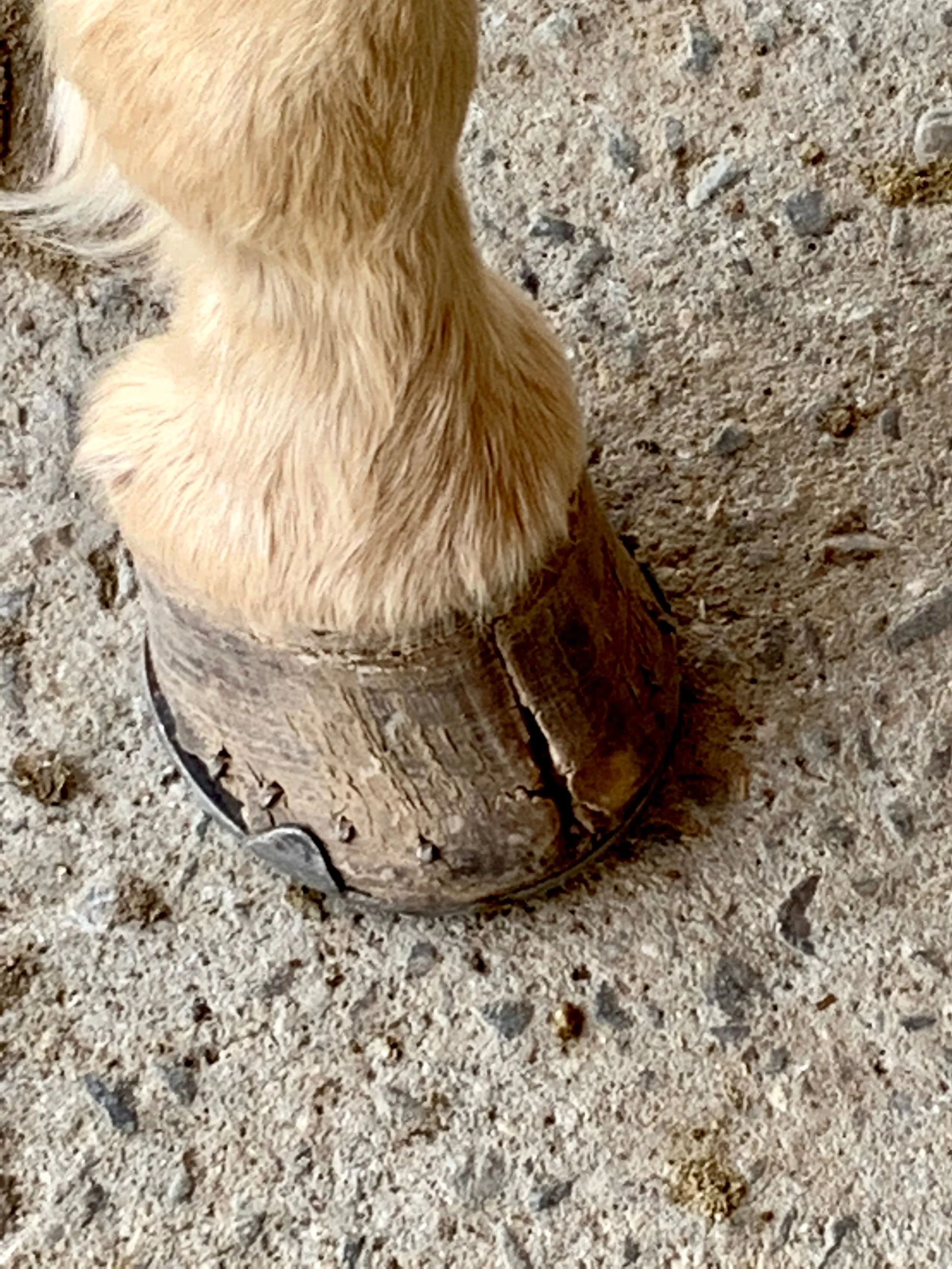
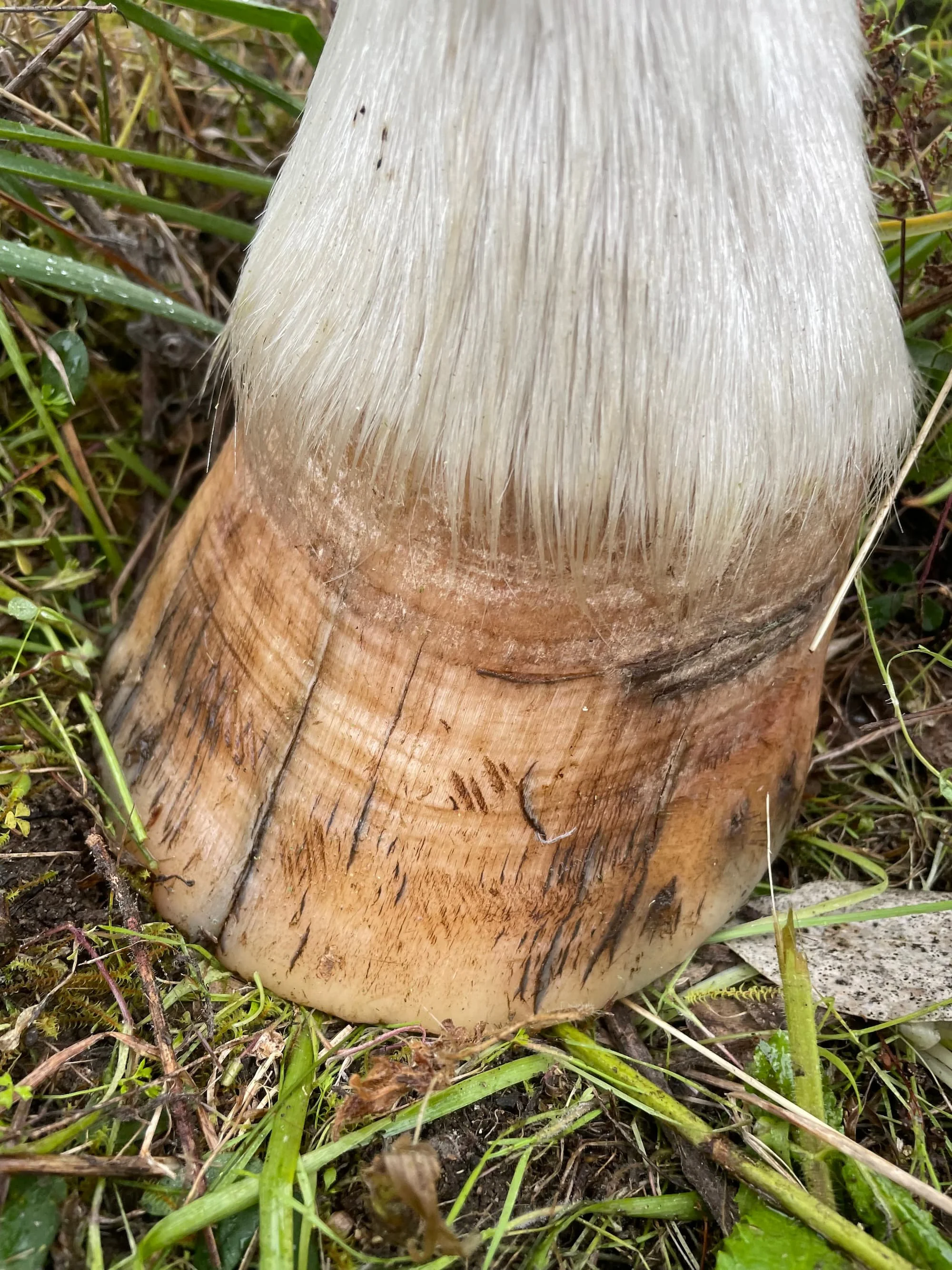
High forage diets are beautiful for gut health. AND they are also inherently low in copper and zinc, two trace-minerals critical for healthy hoof growth. Horses on high forage diets without correct trace-mineral supplementation, will eventually end up with chipped, cracked, slow growing hooves that are prone to conditions like abscesses, thrush and mud fever.
These trace-mineral deficiencies are like the white-ants of a horse’s hooves. They do damage over a long period of time that is not necessarily visible, until hoof problems become painfully evident!
Macro-minerals like calcium and high-quality protein (for essential amino acids like methionine) are also critical for healthy hooves and make up important pieces of a balanced diet.
To balance your horse’s diet, you must be using a high-quality vitamin and mineral supplement, or balancer pellet, or fortified feed at the correct manufacturer recommended feeding rate for your horse’s weight and workload.
If your pasture or hay are poor quality, you can also add some higher quality protein in the form of lucerne and/or clover hay, properly heat-treated soybean, lupins or fortified feeds with high quality protein.
Where do hoof supplements fit?
Hoof supplements definitely have a role to play. Typically they contain some combination of biotin, copper, zinc and amino acids, especially methionine, to help speed up and support healthy hoof growth.
I use hoof supplements in situations where horses have active hoof problems and we want the hooves to grow a little faster, a little stronger and a lot healthier.
If your horse has healthy hooves, and you are feeding a diet that supports gut health and provides all of the nutrients your horse needs, a hoof supplement is not necessary as a preventative measure, the diet you are feeding and your horse’s hindgut microbes will do the work for you!
A quick note on laminitis
If you have a horse with any kind of metabolic condition involving insulin dysregulation that puts them at risk of laminitis, there is a host of other precautions you need to take for hoof health in your precious equines!
Very briefly, you need to feed forages that contain less than 10% non-structural carbohydrate, avoid ALL cereal grains or feeds containing any form of cereal grain or grain by-product (including many of the feeds that say they are grain free and ‘safe for laminitis’!), and be very careful with pasture access, especially in spring and autumn, remembering that early morning grazing is safest, but not always safe!
Hoof health starts on the inside!
Hoof health is definitely born from the inside of your horse! While our wonderful farriers and trimmers will keep our horses’ hooves in functional shape from the outside, we need to give them the best possible ‘material’ to shape, in the form of strong and healthy hoof tissue! And the only way to get that is to feed a diet that supports a healthy gut with a diverse population of microbes AND to make sure you feed a balanced diet meeting all of your horse’s nutrient requirements.
For more information on feeding a balanced diet that will support gut and hoof health, listen to Happy Horse Nutrition Podcast “Episode 1 – Feed your horse like a horse”
About the Author
Dr Nerida McGilchrist
Dr Nerida McGilchrist is an Australian equine nutritionist with a PhD and over two decades of experience. As the founder of Equilize Horse Nutrition, and advisor to some of the world's largest nutrition companies, she’s built an international reputation for blending science with practical solutions. Now, she’s bringing her expertise to My Happy Horse to make advanced nutrition accessible to all.
Get help assessing your horse's diet and building a balanced feeding plan. Download the MyHappy.Horse app and feed with more confidence.