
Feeding for a Healthy Gut (And the two things you must do BEFORE reaching for a supplement)

I hope you find this blog post helpful! If you want a custom diet specific to your horse, click here.
P.S. We love AI, but this content is 100% human generated. 💕
Author: Dr Nerida McGilchrist | PhD Equine Nutritionist and Founder of My Happy Horse
Gut health has sprung to the forefront of popular topics in the world of horse nutrition in the last decade. And the number of gut health supplements on the market has exploded.
With good reason. For gut health is THE foundation of horse health.
Your horse’s gut controls everything from feed digestion and your horse’s ability to maintain weight, right through to behaviour, immune function, muscle energy generation and hoof health, as well as a plethora of other health parameters including things as unlikely as bone and lung health!
Essentially, if your horse has an unhealthy gut, your horse is unhealthy.
And chances are with an unhealthy gut, their behaviour will be off kilter too!
Do the supplements work?
Let’s cut to the chase here and answer the big question first, do gut supplements work?
Short answer is, if they are well formulated (which happily, many are) they can work wonders!
BUT…
Gut supplements are not miracle workers, and they can only do so much.
By far the much more important consideration when feeding for gut health is the diet you are feeding… primarily the forages and grains.
If you feed too little forage, or too much or the wrong type of grain, you will cause huge gut health issues that a supplement, no matter how good, will be near powerless to resolve.
Using a supplement in these situations would be the equivalent of using a garden hose to put out a raging bushfire… ineffective and a waste of time.
Let’s look, therefore, at the foundational nutrition strategies of feeding for gut health!
Rule #1 – Feed Lots of Forage
Forage is the super star when it comes to gut health! Forage is full of fibre and that fibre is critical for:
Encouraging chewing and saliva production. The saliva then dilutes and buffers the gastric acid in the stomach and lowers the risk of squamous gastric ulceration (the ulcers in the top part of the stomach).
Keeping the stomach full of fibre to prevent acid being splashed or squeezed up onto the top section of the stomach, again reducing the risk of squamous gastric ulceration.
Feeding the good, fibre fermenting bacteria and fungi in the hindgut. These good microbes are responsible for digesting fibre, producing vitamins (including biotin to keep hooves healthy and vitamin B1 and B2 for normal behaviour and muscle energy generation), hormones (including the happy hormone dopamine), maintaining a healthy gut wall so the gut doesn’t leak muck into your horse’s body and set up systemic inflammation, maintaining proper immune function AND maintaining proper gut-brain axis communication for normal, calm behaviour.
When there is not enough forage in a diet, your horse is at a massively increased risk of gastric ulceration and a disturbed hindgut microbiome. To avoid both significant gut health issues, you MUST feed LOTS of forage!
What is LOTS of forage?
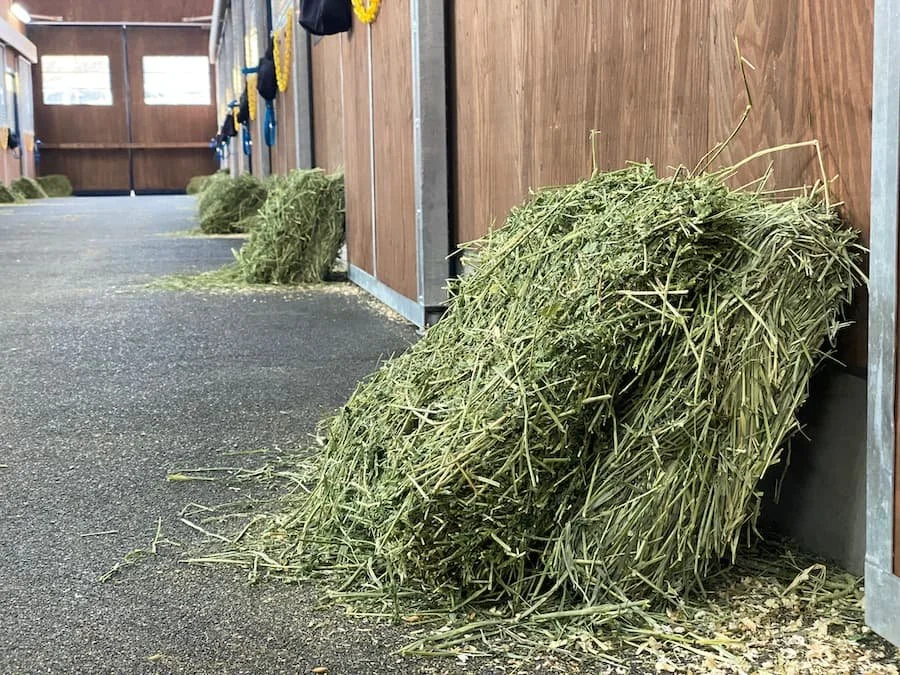
LOTS of forage is at least 2% of your horse’s bodyweight in hay per day (Table 1), or access to ample pasture 24/7, or a combination of plenty of pasture and hay.
| Bodyweight (kg) | Minimum hay per day for a healthy gut |
|---|---|
| 200 | 4 kg |
| 300 | 6 kg |
| 400 | 8 kg |
| 500 | 10 kg |
| 600 | 12 kg |
| 700 | 14 kg |
Table 1: How much hay does your horse need? Amounts shown are 2% of bodyweight for ponies and horses at various weights.
Rule #2 – Be Careful with Cereal Grain!
Cereal grains have the ability to completely ruin your horse’s gut health!
If you feed too much or the wrong type of cereal grain, the starch they contain (the white stuff in the middle of grains like wheat, barley, corn, oats or rice) ends up in the hindgut.
Here, it is rapidly fermented by the ‘bad’ bacteria and these ‘weedy, greedy critters’, to quote microbiologist Dr Belinda Chapman, rapidly take over the hindgut, produce excess acids and kill off your horse’s good microbes.
If that happens, your horse is in a world of hurt! They have lost their friends the good microbes, and that leads to all sorts of issues with reduced digestion, disrupted vitamin and hormone production, altered behaviour, a wonky immune system, leaky gut, systemic inflammation, terrible performance and worst case, laminitis and death!
Which means, when we feed grains to our horses, it MUST be done carefully!!
Cereal grains are fed in diets as a source of energy and as such you should only ever feed them if your horse can’t get enough energy to maintain weight and energy levels on forages and fibres alone. If your horse can maintain weight and energy on forages and fibres, don’t feed grain (or grain-based feeds like pellets or sweetfeeds)!
If you do feed grains, ideally, keep the amount to less than 0.5 kg per 100 kg of bodyweight per day, with a hard rule to NEVER exceed 1 kg per 100 kg of bodyweight per day… and this hard rule applies even to thoroughbred racehorses!
| Bodyweight (kg) | Ideal maximum per day | Absolute maximum grain per day |
|---|---|---|
| 400 | 2 kg | 4 kg |
| 500 | 2.5 kg | 5 kg |
| 600 | 3 kg | 6 kg |
| 700 | 3.5 kg | 7 kg |
Table 2: Be careful with grain and don’t feed too much! Amounts shown are the ideal maximum (0.5 kg/100 kg BW) and absolute maximum (1 kg/100 kg BW) for horses at various weights.
Again, if you don’t ‘need’ to feed grains or grain based feeds, don’t!
Only feed cooked grains!
In addition to being careful with the amount of grain you feed, you must also be careful with the TYPE of grain you feed.
With the exception of oats, only feed cooked grains! The starch in uncooked grains like crushed barley or cracked / sliced corn is near indigestible, and a vast majority of it will end up in the hindgut doing untold damage!
Cooked grains include grains like boiled, extruded, properly micronized or properly steam flaked grains.
Bonus points
For bonus gut health points, feed a variety of forages and alternate fibres. The more variety in forages and fibres you can get into your horse’s diet, the more fibre variety in the hindgut.
This fibre variety supports microbe diversity. And a hindgut with a diverse population of microbes is stable and difficult to knock out of balance… which keeps your horse healthier, allows them to cope with stressors like travel and competition better, helps them recover faster AND reduces the risk of diseases including colic!
For forage variety, feed as many different types of hay as you can find and/or create pastures with as many different edible species as you can manage! And, feed alternate fibres like beet pulp, high quality copra meal, lupin hulls, flaxseed meal, hemp hulls or any other safe, high fibre ingredient that happens to take your fancy! The more fibre diversity, the merrier the good microbes!
Keep feeding for gut health simple
The foundations of gut health are built on feeding LOTS of forage, feeding a variety of forages and fibres and being very careful with how you feed cereal grains.
And the diet MUST be balanced to provide all of your horse’s required vitamins and minerals. Plus give them constant access to free choice salt and very clean, fresh water.
Do all of this, and you will be well on the way to pristine gut and overall health in your horses! And with that, you get a calm, happy horse that you can enjoy your time with!
For more information on feeding for gut health, listen to the Happy Horse Nutrition Podcast, episode 9 – Hindgut microbes and their impact on everything; and episode 10 – Four rules for a healthy hindgut.
About the Author
Dr Nerida McGilchrist
Dr Nerida McGilchrist is an Australian equine nutritionist with a PhD and over two decades of experience. As the founder of Equilize Horse Nutrition, and advisor to some of the world's largest nutrition companies, she’s built an international reputation for blending science with practical solutions. Now, she’s bringing her expertise to My Happy Horse to make advanced nutrition accessible to all.
Get help assessing your horse's diet and building a balanced feeding plan. Download the MyHappy.Horse app and feed with more confidence.