

Rapid Diet Check for Vets
A practical, 3 step nutrition triage you can do in minutes
Good nutrition sits under every metabolic, immune and gastrointestinal process you treat in practice. The challenge is doing a meaningful diet assessment when you are in the field and tight on time.
This page summarizes the three step Rapid Field Assessment from Dr Nerida McGilchrist (presented as an invited paper at AAEP 2025).
Need to check a diet right now?
Download the MyHappy.Horse App (available on iOS) and use the ‘Rapid Diet Check’ point of care tool for veterinarians.
Why a rapid nutrition check belongs in every consult
The Rapid Diet Check gives you a structured way to answer one key question quickly:
Is this horse fed in a way that could be contributing to the problem in front of me?
Modern feeding practices are strongly linked with:
Colic and hindgut dysbiosis
Equine gastric ulcer syndrome
Laminitis driven by insulin dysregulation
Behaviour change, poor performance and welfare issues
And, many vets report low confidence in doing full ration analyses in the field.
A rapid field assessment of a horse’s diet allows you to discover any major red flags during a a consult so you can give clear, evidence based advice on the spot, including recommending a more detailed diet analysis where needed.
Here it is as the 30 second version:
Is the horse receiving at least 1.5 percent of bodyweight per day as forage?
Is total cereal grain intake less than 1 lb per 100 lb BW?
Is there at least one supplement, balancer pellet or fortified feed at an appropriate rate?
If any answer is “no”, nutrition is very likely contributing to the problem in front of you and is worth correcting as part of your treatment plan.
The 3 Step Rapid Field Assessment
The Rapid Field Assessment is designed to be done in a few minutes, using information you can gather in any yard or stable.
For the full field assessment, you are looking at:
Step 1 - Forage and cereal grain
Step 2 - Body condition, weight trend and supplementary feed
Step 3 - Product suitability and feeding rates
Step 1 – Forage and cereal grain
1. Is there enough forage?
Use the horse’s bodyweight and the owner’s stated hay allowance (or weigh it if possible).
Calculate:
hay fed ÷ bodyweight × 100 = percent BW as ha
Quick triage thresholds are:
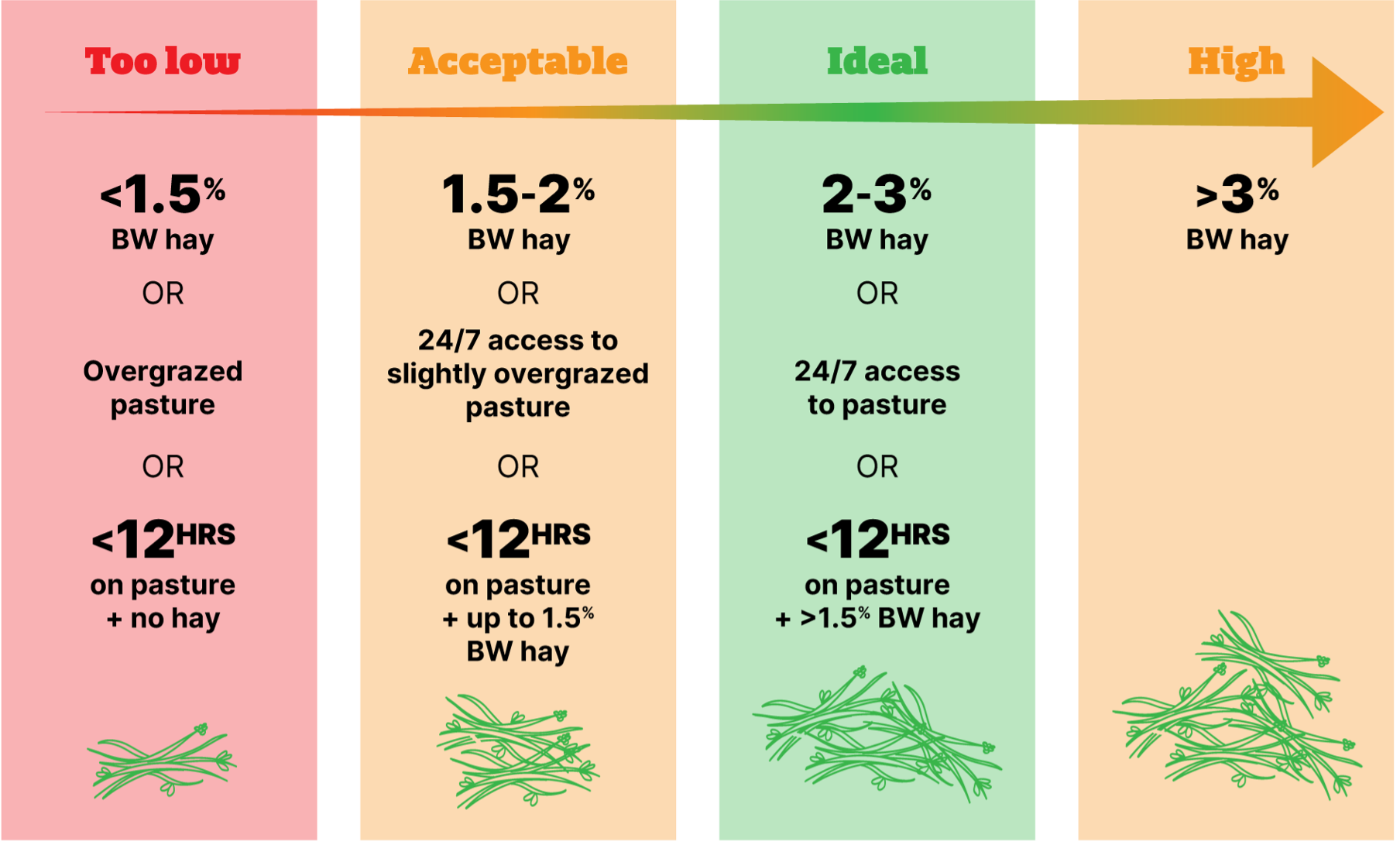
Forage intake quick triage
Too low: Less than 1.5% of bodyweight (BW) as hay, or overgrazed pasture, or less than 12 hours on pasture with no hay.
Acceptable: 1.5–2% BW as hay, or 24/7 access to slightly overgrazed pasture, or less than 12 hours on pasture plus up to 1.5% BW hay.
Ideal: 2–3% BW as hay, or 24/7 access to pasture, or less than 12 hours on pasture plus more than 1.5% BW hay.
High: More than 3% BW as hay.
Why this matters: Adequate forage intake is a fundamental part of a healthy equine diet.
2. Is forage type and quality appropriate?
Most diets should be grass based, with legumes used strategically.
Use the hay quality graphic to align what you see with what the horse needs:
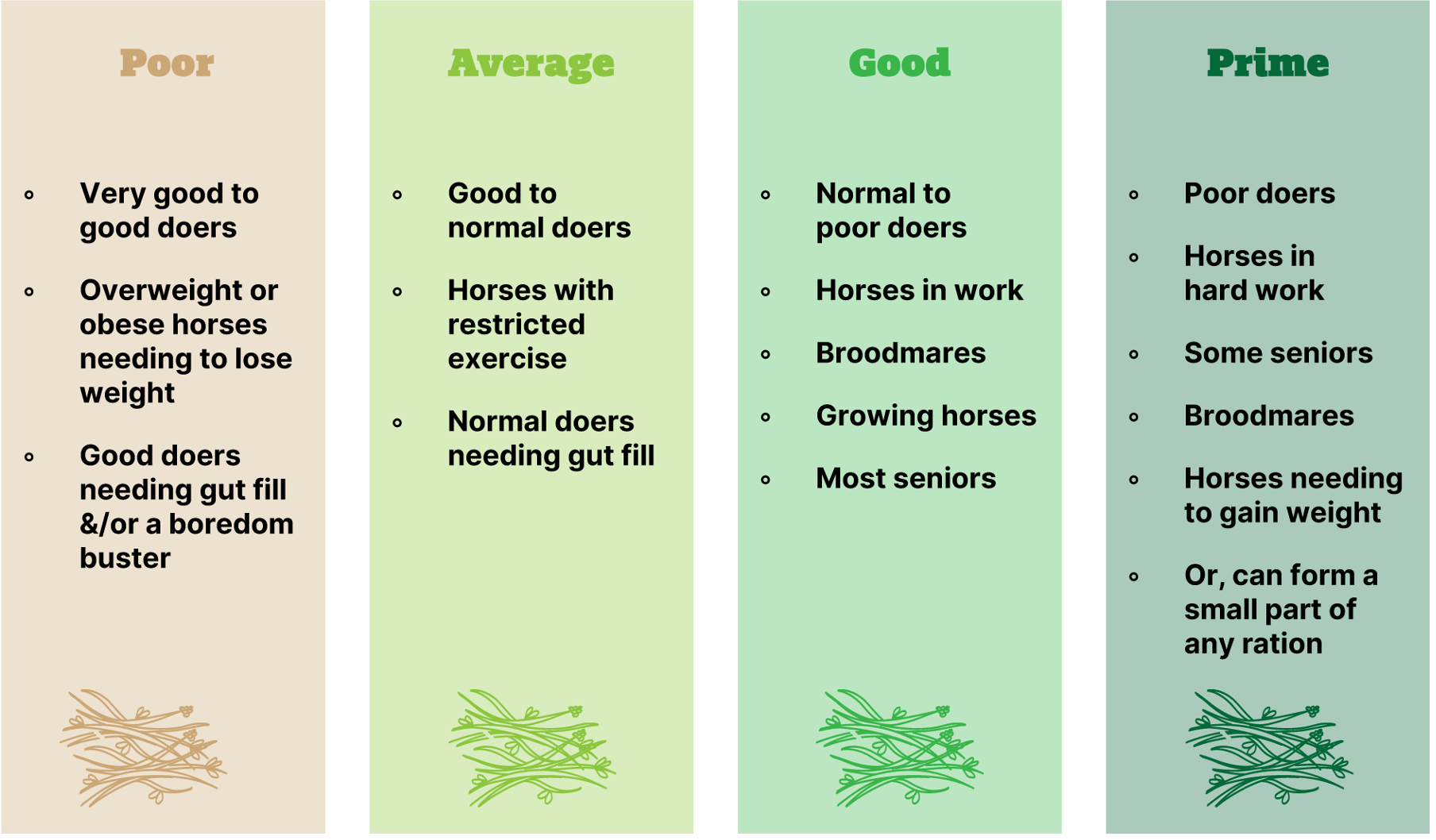
Forage quality guide
Poor
Very good to good doers
Overweight or obese horses needing to lose weight
Good doers needing gut fill and/or a boredom buster
Average
Good to normal doers
Horses with restricted exercise
Normal doers needing gut fill
Good
Normal to poor doers
Horses in work
Broodmares
Growing horses
Most seniors
Prime
Poor doers
Horses in hard work
Some seniors
Broodmares
Horses needing to gain weight
Or, can form a small part of any ration
3. Is there at least some forage variety?
Aim for at least two plant species in the forage.
Grass plus legume combinations support fibre and microbiome diversity, and therefore hindgut resilience
4. Is cereal grain amount acceptable?
Convert grain intake to pounds (or kg) per 100 lb (or 100 kg) bodyweight and compare with the cereal intake graphic.:
Amount of grain fed per day / (BW in lbs / 100) = lbs of grain per 100 lb BW
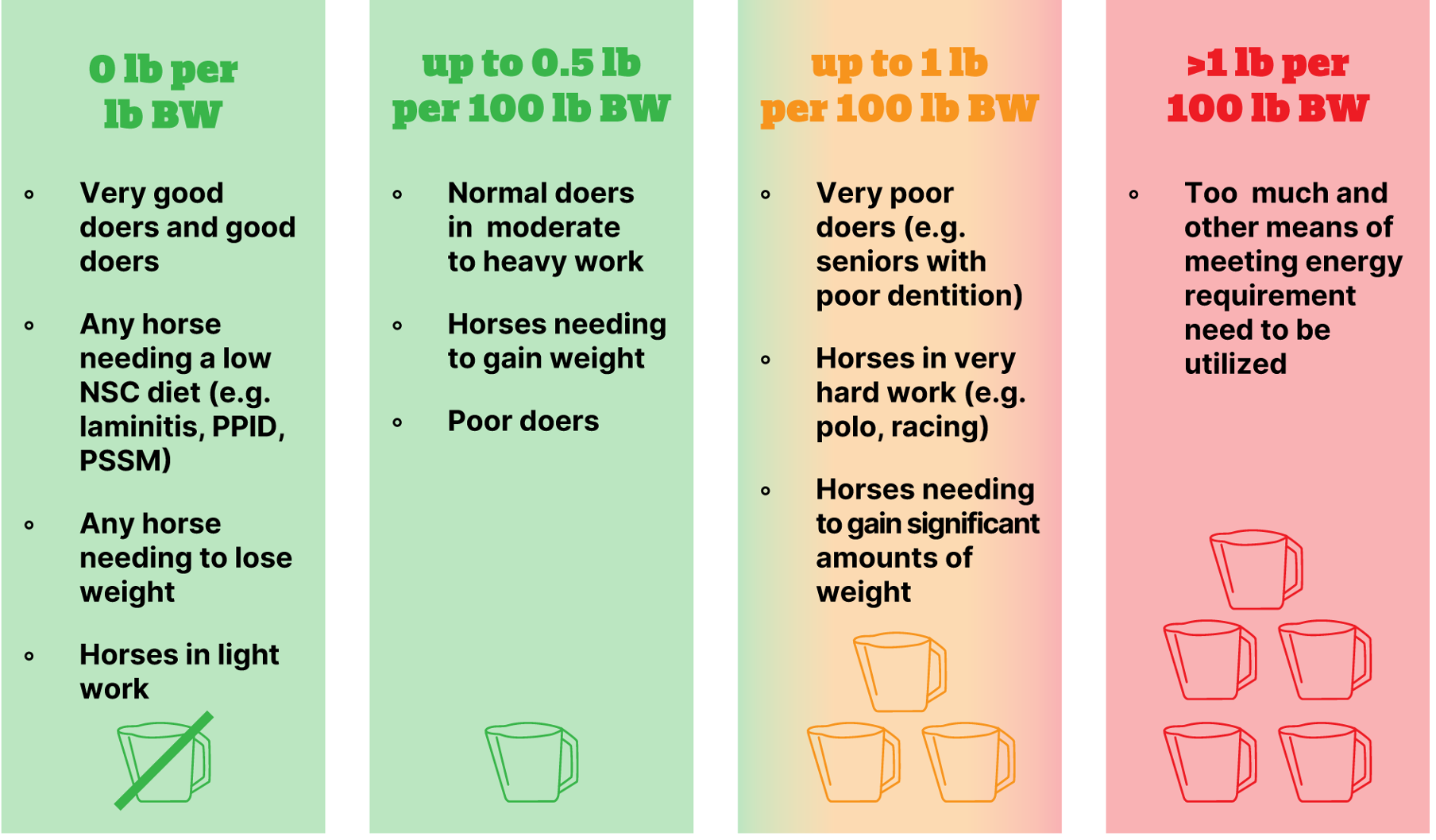
Cereal grain intake quick triage
0 lb per lb BW: Very good doers and good doers; any horse needing a low NSC diet (e.g. laminitis, PPID, PSSM); any horse needing to lose weight; horses in light work.
Up to 0.5 lb per 100 lb BW: Normal doers in moderate to heavy work; horses needing to gain weight; poor doers.
Up to 1 lb per 100 lb BW: Very poor doers (e.g. seniors with poor dentition); horses in very hard work (e.g. polo, racing); horses needing to gain significant amounts of weight.
More than 1 lb per 100 lb BW: Too much, and other means of meeting the horse's energy requirement need to be utilized.
5. Is the grain likely to be digested in the small intestine?
Poorly digested grain, even at moderate intakes, pushes starch into the hindgut and increases risk of acidosis, leaky gut and laminitis.
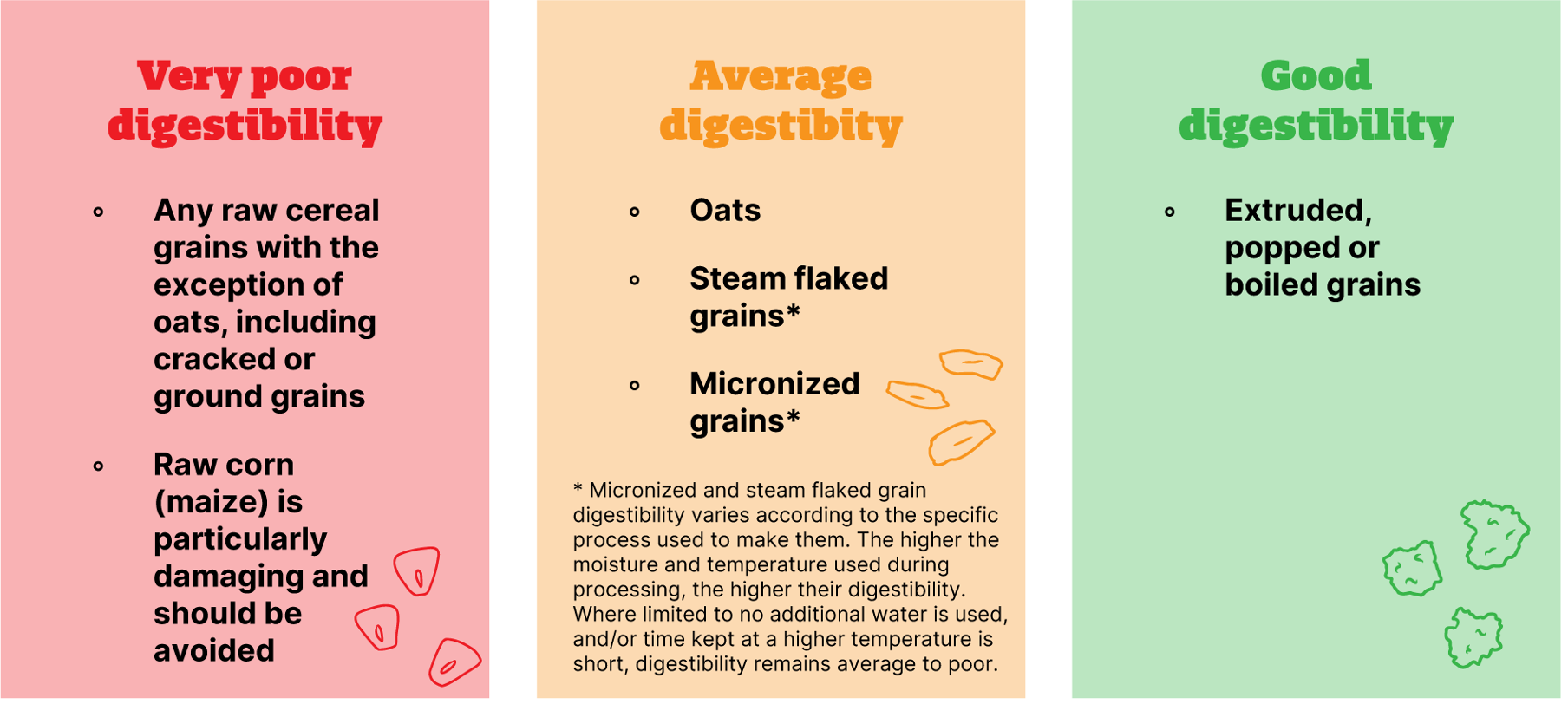
Cereal grain digestibility
Very poor digestibility
Any raw cereal grains with the exception of oats, including cracked or ground grains
Raw corn (maize) is particularly damaging and should be avoided
Average digestibility
Oats
Steam-flaked grains*
Micronized grains*
Good digestibility
Extruded, popped or boiled grains
* Micronized and steam-flaked grain digestibility varies according to the specific process used to make them. The higher the moisture and temperature used during processing, the higher their digestibility. Where limited to no additional water is used, and/or time kept at a higher temperature is short, digestibility remains average to poor.
Step 2 – Body condition, weight trend and supplementary feed
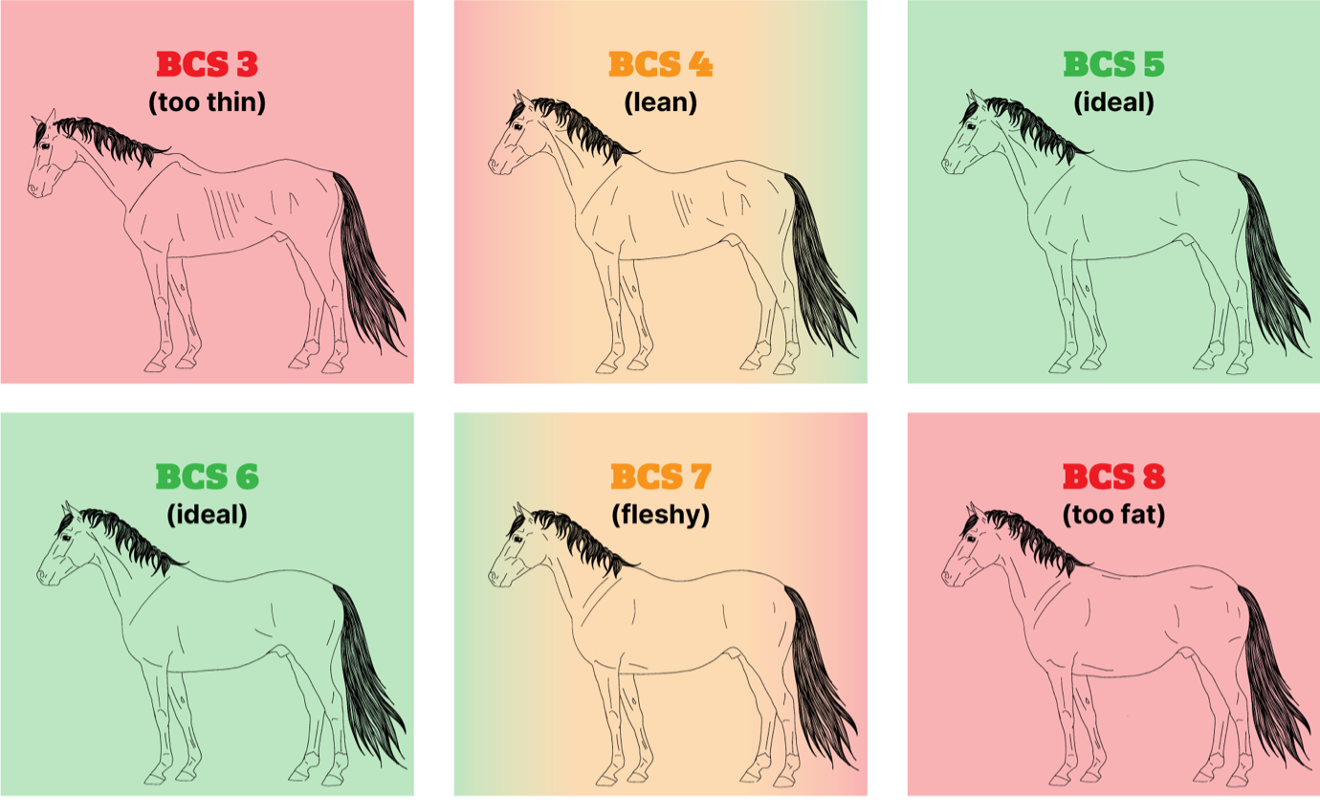
1. Body Condition Score (BCS)
Use the Henneke 1 to 9 scale[29]. Briefly, easily visible ribs (BCS <4), indicate the horse is thin, whereas hard to feel ribs and/or a neck starting to fill with fat (BCS>6), suggest excess weight.
BCS guide:
BCS 3: Too thin
BCS 4: Lean
BCS 5: Ideal
BCS 6: Ideal
BCS 7: Fleshy
BCS 8: Too fat
2. Is the horse losing, gaining or holding weight?
Determine current state of weight change; is the horse losing, gaining or holding weight.
Use historic weight measurements, the horse owner’s observation or your own periodic observations of the horse to determine weight change.
3. Does the calorie intake match the horse in front of you?
Broad triage:
Likely appropriate if
BCS is in the target range and weight is stable
Thin horse is gaining
Overweight horse is losing
Potentially inappropriate if
Ideal BCS but active weight gain or loss
Thin horse is only holding or still losing
Fat horse is holding or still gaining
Step 3 – Product suitability and feeding rates
Here you are checking if the vitamin and mineral supply makes sense.
Commercial products designed to meet vitamin & mineral requirements usually fall into three groups:
Vitamin and mineral supplements
Balancer pellets
Fortified feeds
All are formulated to meet requirements when fed at their intended rate. Underfeeding any of them means nutrient gaps. Overfeeding increases cost and, in some cases, risk of toxicity.
A simple way to check:
Convert each product to a fraction of its recommended rate
Add the fractions together
For example:
Product 1: fed at half the recommended rate → 0.5
Product 2: fed at half the recommended rate → 0.5
Combined: 0.5 + 0.5 = 1.0 → roughly 100% of intended combined rate
If the total is:
< 1.0 – likely vitamin and mineral deficiencies
> 1.0 – oversupply of some nutrients
0 (no product) – major gaps, especially for horses on conserved or mature forage
How the MyHappy.Horse Rapid Diet Check helps
The Rapid Diet Check in the MyHappy.Horse app does all the heavy lifting for you and flags red and amber risks. You can discuss these risks with the horses owner and agree on next steps.
Get started
Open Rapid Diet Check for Vets
Enter details and review summary
Share with the horse owner and recommend next steps
Summary
The Rapid Field Assessment gives you a practical, three step structure to decide whether nutrition is likely to be helping or hindering the horse in front of you. The MyHappy.Horse Rapid Diet Check turns that structure into a quick, app based tool that helps you:
See the diet clearly
Communicate risks simply
Make better feeding recommendations with confidence
Use it alongside your usual clinical workups to bring nutrition into every case where it matters.